
Who does science funding select for?


In the previous article on grant lotteries, I ended on a note that the core problem with scientific funding is not just about how you allocate a scarce resource, but about how scarce that resource has become, and how much collective energy is now spent competing for it. There is a related question to that which I've talked about with other researchers in similar points of their career: even if the grading and selection process were somehow made perfectly fair, would the people left competing in it actually be a representative sample of scientific talent?
The Matthew effect in grant funding
A big piece of evidence here comes from a 2018 PNAS study by Thijs Bol, Mathijs de Vaan, and Arnout van de Rijt, who analyzed data from NWO's Veni program, the early-career fellowship that functions as the primary individual funding route for young researchers in the Netherlands. NWO uses a hard numerical threshold to separate funded from unfunded applications. Applicants just above and just below the cutoff have near-identical review scores, so near the threshold the funding decision can be seen as pretty much random. Based on this, you can compare what happens to those two groups in the years that follow.
What they found is that winners just above the threshold accumulated more than twice(!) as much research funding over the following eight years compared to near-winners who scored just below it. The gap opened early and widened year by year. And beyond money, winning a Veni grant raised the probability of holding a full professorship ten to sixteen years later by roughly 50%! Unless you believe that this small difference in score is somehow precisely where 'good' and 'bad' researchers are separated, this points to the system not working correctly.
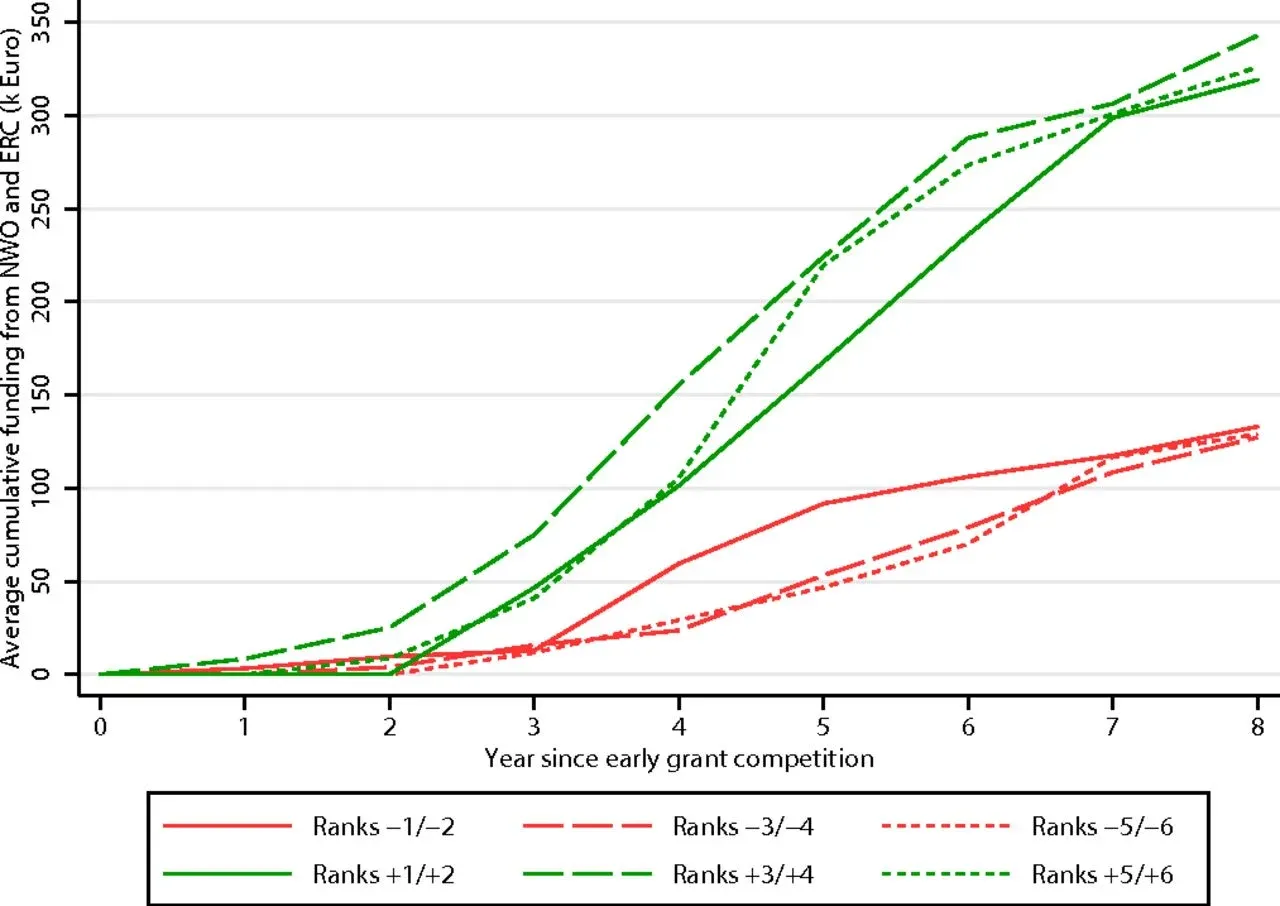
This effect has been known for a long time in various different context - the Matthew effect (or more descriptively, "Cumulative advantage"). In simple terms it's just that the rich get richer: winners get resources, time, institutional support, and a track record of success that makes the next application stronger. Near-winners get none of that, despite having a close starting point. By the time the Vidi competition comes around five years later, you can guess which group gets funding. What the next round of applications is being judged on is in part a consequence of the earlier decision, rather than a difference in scientific quality of an applicant. The outputs the system uses to justify its selections are partly created by the selections themselves, which becomes a self-reinforcing loop.
This is already a significant problem with how funding competitions tend to describe themselves. But the Bol et al. result only deals with what happens after a funding decision. There are earlier filters that decide who can pursue a scientific career.
Who makes it to the application stage
The pool of people who reach even an early carreer grant like a Veni application is perhaps not the best sample of early-career scientific quality. It is a group defined partly by who could survive the preceding years of postdoc. This means fixed-term contracts, and usually moving to different countries (which is often recommended if not directly said to be required for a scientific career). This comes at ages when most people are also making long-term financial decisions, or starting families. Many fellowship schemes formally require applicants to have left their PhD institution, embedding geographic displacement as a criterion in the application itself.
A 2022 qualitative study by Schaer following early-career researchers across European academic systems found that international mobility has become formally or informally required to stay in academia, while there is essentially no good option for those who cannot or do not want to move. The uncertainty itself selects for a specific kind of person with specific circumstances: someone who either has the financial cushion to absorb years of instability, or whose personal situation happens to be light enough to make repeated relocation feasible.
The postdoc stage, precisely when mobility is most expected and most rewarded, tends to coincide with family formation for many researchers. Large-scale survey work across tens of thousands of researchers in North America and Europe consistently find that having children is associated with measurable drops in publication rates and citation accumulation. As you might expect, this effect is larger for mothers than fathers, and leads women in academia being less likely to have children than their male peers at the same career stage.
There is also a prestige hierarchy in faculty hiring that sits on top of all of this: a small number of elite institutions produce a disproportionate share of faculty hired across academia, a structure that has been stable for decades and that correlates strongly with the financial and social capital required to access those institutions in the first place. This means that part of the first-stage filter operates even earlier, at the point of choosing where to do a PhD, long before any postdoc begins.
What this amounts to is a two-stage selection process that gets described as a single quality filter. The first stage runs for years before any application is ever filed, and it filters not only on scientific ability but also on financial resilience, the nature of your relationship and family situation, the absence of certain caring responsibilities at critical career moments, and a willingness to sacrifice personal stability for long term career. The second stage is the formal grant competition, which is noisy in ways described in the lottery piece, and whose outcomes then compound through cumulative advantage as described above.
None of this is to say that scientific careers are purely about privilege, or that ability plays no role. It does suggest that science funding policy has a tendency to optimize for multiple things at once, which do not necessarily have to be scientific ability.