"Natural" products, and why people like them

Meier, Dillard, and Lappas (2026) published "The naturalness bias" in Current Opinion in Psychology, and it only runs to about two printed pages - probably the shortest paper I've ever read. Despite it's length, the paper touches upon an interesting topic: what's the fuss with all the "natural" labels we see?
The naturalness bias is the tendency to prefer things labeled as "natural" over synthetic or human-made equivalents, even when objective information says the distinction is irrelevant. Research has documented this across a large range of domains: drugs, vaccines, food, cigarettes, human talent, and even artificial lighting. In a 2025 series of behavioral experiments by the same research group, between 66% and 84% of participants chose and followed through with the "natural" option across tasks ranging from picking a sticker to agreeing to a drug injection. The word alone did the work.
In earlier hypothetical drug scenarios, roughly 80% of participants preferred the natural option when safety and efficacy were described as equal, and around 20% maintained the preference even after being told the natural drug was less safe. The bias was stronger than the stated information. It reaches into professional practice as well: around 31% of obstetricians and gynecologists in one study expressed a preference for natural hormone replacement therapy when both options were described as identical.
In a way, this is an appeal to nature fallacy, the inference that because something is natural it must be good, and synthetic must be worse. This is clearly a fallacy; plenty of toxic compounds are natural, while plenty of good compounds are synthetic.
Earlier work established that perceived safety is a central driver. People tend to believe natural items are inherently safer, and correcting that specific belief can reduce the preference in controlled settings. The 2026 paper describes a second proposed mechanism: science skepticism. People who score higher on naturalness bias measures also tend to score higher on science skepticism, and the paper argues that understanding how these two factors relate to each other is a meaningful open question for intervention design.
You can believe a natural product feels safer while still broadly accepting scientific consensus, but if general distrust of science is driving the safety misconception, then better product-specific information won't help. Providing clearer data from a distrusted source is not a solution to solving the distrust.
The problem at hand is quite relevant in modern times. The naturalness bias is a significant predictor of vaccine hesitancy, it steers people toward untested herbal remedies, and it was associated with reduced intention to receive a COVID-19 vaccine in earlier work by the same group. A preference for natural approaches can also lead to delayed diagnosis and delayed treatment, which harms outcomes independently of the alternatives chosen. In short: it's a health hazard when people get stuck in the naturalness bias.
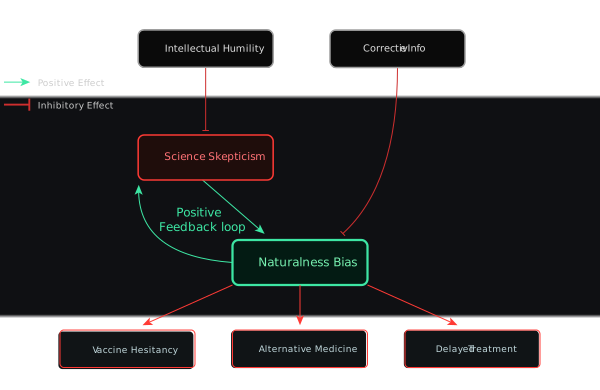
What can be done about this bias? Intellectual humility (the ability to recognize that one's beliefs might be wrong) correlates with a weaker naturalness bias and a greater willingness to choose synthetic options, and rational appeals that directly challenge safety perceptions reduce the preference, at least in the short term. The problem the authors identify is that if science skepticism and the naturalness bias reinforce each other in a feedback loop, interventions that address one factor in isolation will probably not work. As usual, I imagine that a combination of better science education, explanations of epistemology, and perhaps some better information are key to solving the problem.