
Why trees, neurons, and arteries look the same
Whenever I drive to work in winter, I cannot help but see comparisons between the branches of the trees and the neurons I look at under the microscope. They share some structural details:

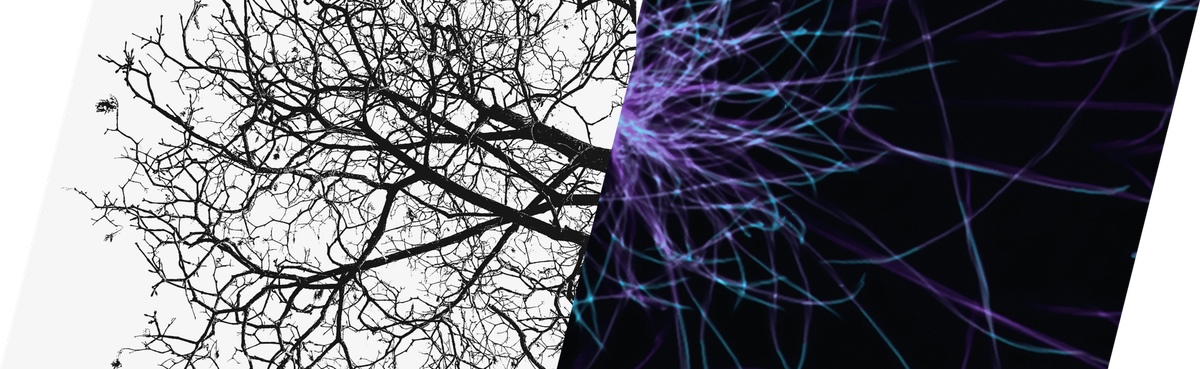
Whenever I drive to work in winter, I cannot help but see comparisons between the branches of the trees and the neurons I look at under the microscope. They share some structural details: a trunk that splits into progressively thinner branches, the branches getting shorter and finer at every node, the whole structure terminating in a finely distributed shape. Side by side, you could fool me if you only drew out the geometric shapes.
I got curious about what the biological, or really mathematical, explanation for this is. Trees grow their shape under sunlight, gravity, and wind. Vascular "trees" evolved under pressure and a blood budget. Dendrites and axons develop under selection for synaptic integration and signal speed. From up close these look like very different problems optimizing for different costs, yet the geometry has a lot of similarities. Why is that?
The first hint comes from 1926, when Cecil Murray derived what is now called Murray's law for the vascular system. He studied how blood is pumped through vessels. Pumping blood through a narrow vessel costs energy: by Poiseuille's relation, the resistance scales as 1/r⁴, so narrow vessels are expensive to push fluid through. But maintaining the blood inside a vessel also has a metabolic cost, and that scales as r², so big vessels are expensive to keep filled and oxygenated. This balance means that there's a sweet spot. If you minimize the sum of the two costs, the optimal vessel turns out to carry a flow proportional to r³. This means that at any bifurcation, the cube of the parent radius equals the sum of the cubes of the daughter radii. [equation here]
Real mammalian coronary and respiratory trees follow this rule reasonably well across many orders of branching, with the largest deviations sitting where Murray's assumption of laminar Newtonian flow breaks down (the aorta, large turbulent vessels).
Leonardo da Vinci had observed an analogous rule in trees four centuries before Murray: the total cross-sectional area of all branches above a node equals the cross-section of the branch below it. The form of the rule is the same as Murray's, but the exponent is 2 instead of 3: r₀² = r₁² + r₂². Why a different exponent? Trees also transport fluid, sap through xylem, so it may seem like it should have the same optimization. The trouble is the tissue. In a mature tree, the actual sap-conducting wood (the sapwood) is only a thin annulus (sort of a ring shape) near the outside of the trunk. Most of the cross-section is dead structural wood, doing no transport at all. Considering this, it's obvious that the optimization is not based on hydraulics, as it's mostly the diameter of dead wood.
In 2011, Christophe Eloy proposed an alternative. He simulated a self-similar tree skeleton (a fractal structure where the branching pattern repeats at different scales) under wind loading, and asked what the minimum diameter each branch needs to survive the wind coming in is. He did the calculations, and da Vinci's observed rule falls out. The branches are sized by mechanical demand, with wind drag in place of blood viscosity as the cost function.
Neurons turn out to optimize a similar function, but with a third cost. Drawing on more than a decade of silver-stained histology, Santiago Ramón y Cajal set out three laws of economy he believed governed the arrangement of nerve cells: economy of space, matter, and conduction time. Or: the shapes of axons and dendrites should waste as little volume, cellular material, and signal delay as possible. More than a century later, Hermann Cuntz and colleagues showed that you can reproduce real dendritic morphologies using a graph-theoretic optimization in the spirit of Cajal's laws, minimizing a weighted sum of total wire length and path length from each synapse to the soma.
The most general version of this argument was put forward by West, Brown, and Enquist in 1997. They argued that any biological distribution network feeding a three-dimensional body must satisfy three things at once. (1) It must be space-filling, (2) the terminal units (like capillaries, leaves, synapses) must be roughly size-invariant across species, and (3) the energy dissipated during transport must be minimized. A fractal-like, hierarchically branching tree can be derived out of the algebra as a family of solutions to these constraints. This even expands beyond biology, to lightning, rivers, and probably much more.
Trees, neurons, and arteries look alike because there is a small family of good answers to the geometric problem of reaching every point in a three-dimensional volume from a single source, while obeying some local conservation rule at branching points. Whether the fluid is sap, blood, or charge, and the constraint is wind, shear, or signal delay: the shape that comes out the other end is roughly the same. Now, when I drive past leafless trees next February, I'll have a better answer for why they remind me so much of my research.