Should I clean my solar panels?

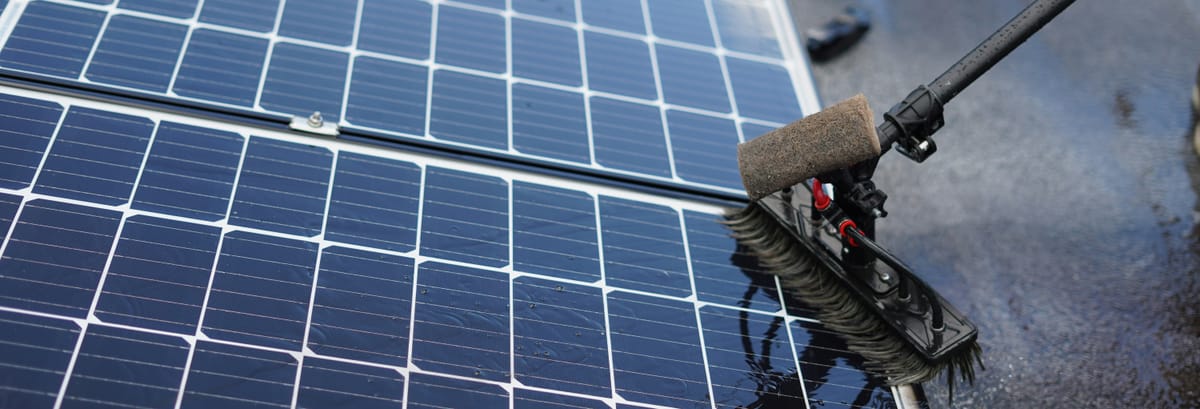
I’ve often heard that it is good to clean your solar panels once in a while, with many companies offering yearly services to come over and clean them for you. This has always been a bit of a dubious story to me; my panels still produce a lot of energy after years of not having been cleaned, and even colleagues of mine argued that things like snow dropping off of the panels would clean them off sufficiently. On the other hand, if I think about a somewhat similar surface, my car’s exterior, it does get really dirty if you don’t wash it now and then. So what’s true? Let’s look at some science and math to figure it out.
When dirt obstructs the light from hitting the solar panel and being converted into energy, we call this soiling loss. The dirt in question can be many things (pollen, sand, bird defecation, brake and tire dust etc), but since these can all affect the efficiency of the panel in different ways, it is common to use the soiling ratio to determine the effect it has. The ratio is the power produced by a soiled reference surface divided by a clean reference surface under the same conditions.
Studies have looked into what factors go into how quickly a soiling ratio turns bad.
- Tilt angle
Steeper panels shed water and particles more effectively. In Dutch consumer guidance, ~20° is often used as a practical threshold where low-tilt installations are more prone to persistent soiling.
- Rain patterns
Frequent rain can wash off loose material. Light rain can sometimes redistribute dirt and leave residues, depending on particle type and local pollution.
- Local environment
Farms, roads, construction, trees (pollen and sap), and coastal salt spray can all increase deposition or adhesion.
- Panel framing
Frames can create small collection zones where water flow slows and dirt accumulates.
Practical data
In 2003, TNO exposed solar panels outdoors near Delft for about a year and evaluated performance and optical effects related to contamination. In their module measurements, they report output reductions on the order of a few percent, with several cases around ~4–8% depending on the specific surface/material and conditions (and they discuss reasons to treat certain cases cautiously).
A more recent Dutch field test gives much lower numbers. In the ASAP project (TNO/DSM/Rebor), panels with coatings were monitored on a farm roof in Noord-Brabant under conditions expected to be relatively dust-rich. After 1.5 years, the main conclusion was that there was no measurable soiling on the monitored PV system. Interestingly, visible soiling was present on the site, yet it was confined to a small area close to a dust-emitting ventilation exhaust. The report’s takeaway is that in the Dutch climate, soiling is often modest at the system level, while being strongly site-specific and localized.
A recent Europe-wide analysis (Fernández Solas et al., 2025) produced geographical estimates of annual soiling losses and, importantly, showed how sensitive the outcome is to one assumption: how effective rain is at cleaning.
They report an average annual soiling loss across Europe of about 0.9% if rain is treated as a “perfect” cleaning agent once a threshold is reached. Under a much weaker assumption (rain removes ~10% of accumulated soiling per qualifying event), the modeled European average rises to about 5.3%. These numbers are in agreement with the upper-bound TNO data from 2003.
Is it worth it?
We can plot the breaking point for when it becomes worth cleaning your panels. This is a function of the price it would cost to clean the panels, the soiling ratio, and of course the number of panels. Implicitly we also take the post of kWh (set to 0.26 euro) into account, and the maximum Wp of the panels (400 in this example).
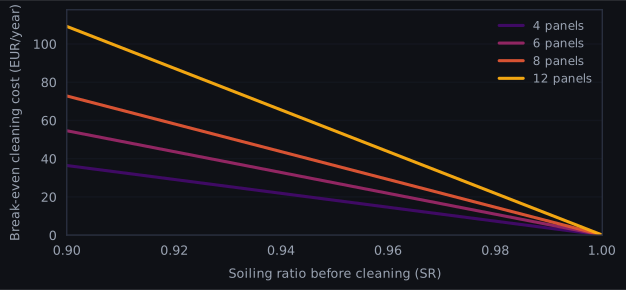
Besides numerical assumptions, a lot of underlying assumptions are also part of it - is soiling a constant factor, or season dependent? How long does cleaning keep a panel clean (we now practically assume a clean year)?
I think the plot presents an absolute best-case scenario for cleaning. Since prices for cleaning often range from 75-150 euro per year (scaling with number of panels you'd have cleaned), it might look somewhat reasonable if you have enough panels. The biggest problem in my mind is that we don't know the soiling rate of our specific panels, and it likely isn't bad enough. Using the worst of the worst-case numbers, let's say we hit 5% soiling on average, the cleaning would still have to be practically the lowest market rate to be viable. And that's not even taking into account that after a few weeks/months, we'd be dropping down to 0.99 again.
Many Dutch roofs with decent tilt will see tiny long-term soiling losses, so a yearly cleaning subscription is probably not worth it. Some roofs could potentially be exceptions: low tilt, nearby farms with nasty chemicals or busy roads, lots of trees and pollen, coastal salt, and terrible bird droppings. If you live near specific areas where dirt is sticky and rain doesn't get rid of a lot of the dirt, it may be an option to do a cleaning every now and then - maybe once in a few years. But for most cases, like mine, it isn't economically viable.